REVIEW · BAKU
Guided Old City Tour on Baku’s Timeless Charm
Book on Viator →Operated by Alov Travel · Bookable on Viator
Baku’s Old City can feel like time travel. This guided tour threads together UNESCO-listed sights in Icherisheher with clear, story-driven explanations from a local guide like Vahid, so the stones make sense fast. I especially like the stop-by-stop pacing and the way the route connects places that are close together but rarely explained as a whole. One thing to consider: a couple of major landmarks have admission charges that are not included.
You’ll get two big wins right away: first, small-group attention (max 15 people), and second, a tour plan that doesn’t rush you past the details. The best part is how the guide ties architecture, trade routes, and religious sites into one story, which makes even the quick stops feel worth your time. The only possible drawback is that it’s compact and walking-heavy inside the Old City lanes, so wear shoes that can handle uneven cobblestones.
For $25, the value comes from more than the sites. You’re paying for context, practical guidance, and a carefully organized route run by Alov Travel, which also shows up in the reviews as being trustworthy and well-timed. Just keep in mind that entrance fees for the Maiden Tower and the Palace of the Shirvanshahs are not included, so you may want to set aside extra money if you want to go inside.
In This Review
- Key things to know before you go
- What this Baku Old City tour is really like
- Starting at Gosha Gala Square: getting your bearings in 10 minutes
- The trade-route rhythm: caravanserais in the Icherisheher lanes
- Maiden Tower and Baku’s signature skyline icon
- Bazar square and religious complexes: how daily life worked
- Gasim Bey Bath and Agha Mikayil Bath House: Old City hygiene as architecture
- Masques, towers, and fortifications: Juma Mosque and the city walls
- More than monuments: Ali Shamsi workshop and the miniature books museum
- Shirvanshahs Palace: the big paid highlight
- Small reminders that make the tour smoother
- Price and value: is $25 a good deal
- Who this tour fits best
- Should you book Alov Travel’s Baku Old City Tour?
- FAQ
- FAQ
- How long is the Guided Old City Tour in Baku?
- What is the price per person?
- Where does the tour start, and where does it end?
- What time is the tour available?
- Is the ticket digital?
- What’s included in the price?
- Are entrance fees included for major monuments?
- How many people are in the group?
- What is the cancellation policy?
Key things to know before you go
- Meeting point at Gosha Gala Square (47 Kichik Qala, Baku), with the tour ending back there.
- Mobile ticket for easy check-in and a smoother start in a busy Old City area.
- Two hours, about 15 stops’ worth of meaning, not just photos.
- UNESCO focus on Icherisheher monuments, including the Maiden Tower and the Shirvanshahs Palace ensemble.
- Multiple free stops plus a couple of paid highlights where entry is not included.
- Local guide storytelling that’s specifically praised, including cultural notes and regional context.
What this Baku Old City tour is really like
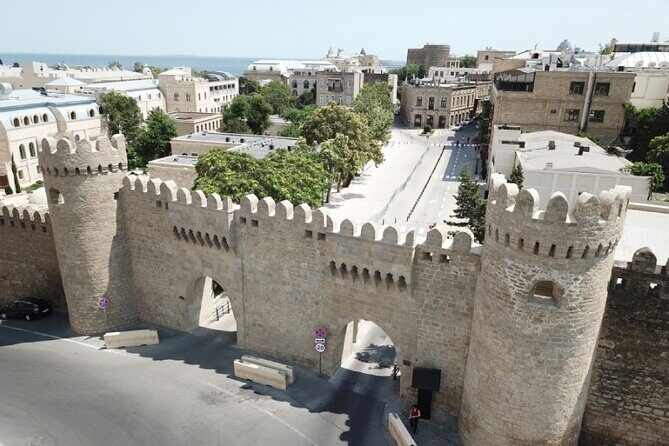
This is a guided walk through the heart of Baku’s historic core, centered on Icherisheher, the UNESCO-listed walled Old City. The tour feels designed for people who want more than a highlight reel. You spend your time understanding why each place exists, how it functioned in medieval life, and why it still looks the way it does today.
The pace is practical: some stops are quick photo-and-facts moments, and others take long enough to appreciate scale and details. In about two hours, you move through gates, caravanserais, religious buildings, baths, and major monuments. There’s also room for small cultural extras along the way, and the reviews specifically mention stops where people tasted local cuisine.
Group size matters here. With a max of 15 travelers, it’s easier to hear the guide and stay together in narrow streets. That’s not a small point in Old City Baku, where it’s easy to feel lost if you’re exploring alone.
You can also read our reviews of more guided tours in Baku



Starting at Gosha Gala Square: getting your bearings in 10 minutes
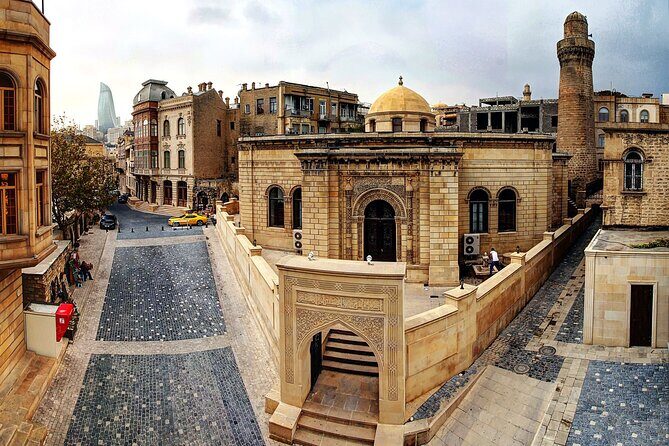
Your tour begins at Gosha Gala Square, 47 Kichik Qala. You’re placed at the right kind of landmark—right near the Old City gates—so your first minutes help you orient yourself. That sets the tone for the rest of the walk. Instead of randomly hopping between sites, you start where the fortifications and entrances connect.
The first stop is the Double Gates of Baku, also known as the Baku Old City Gate or Gosha Gala. These date back to the 12th century and are well preserved as part of the UNESCO World Heritage listing. The practical value of starting here is simple: once you understand what the gate system was for, you notice the logic behind everything else you see—street layout, defensive walls, and the flow of people entering and exiting.
This is the kind of opening stop that helps you stop thinking of the Old City as only pretty scenery. It’s a working system from another era.
The trade-route rhythm: caravanserais in the Icherisheher lanes
After the gates, you move into the parts of Icherisheher tied to commerce. Two caravanserais come up early, and that’s smart because it gives you a framework: in medieval cities, trade buildings were like today’s travel infrastructure—temporary homes for merchants, storage, meeting points, and safe shelter.
First is the Bukhara Caravanserai, built at the end of the 15th century on the commercial highway through the Old City. You learn how the courtyard is planned and why the design works: the raised portal, the octagonal courtyard shape, and the perimeter balconies and private rooms. The guide’s explanations matter here because it’s easy to overlook the architecture when you’re just passing through narrow corridors. With context, you start noticing how the building functioned as an open-air gathering space where travelers and merchants regrouped after trading.
Next is the Multani Caravanserai, established in the 14th century and located across from the Bukhara Caravanserai. This one adds a specific human angle. It housed merchants from Multan (in today’s Punjab region), and the tour connects the trade network to wider religious history too. It’s also linked in the background story to the Zoroastrian community, with a belief that they helped erect the Ateshgah Temple in Surakhani.
If you like seeing how cities were connected beyond today’s borders, these stops deliver. You also get a good lesson in why Old City Baku feels layered: it’s not one culture only, but a stack of influences that show up in building design.
Maiden Tower and Baku’s signature skyline icon
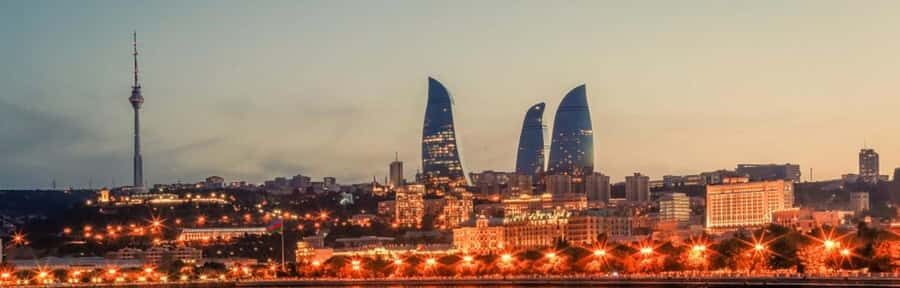
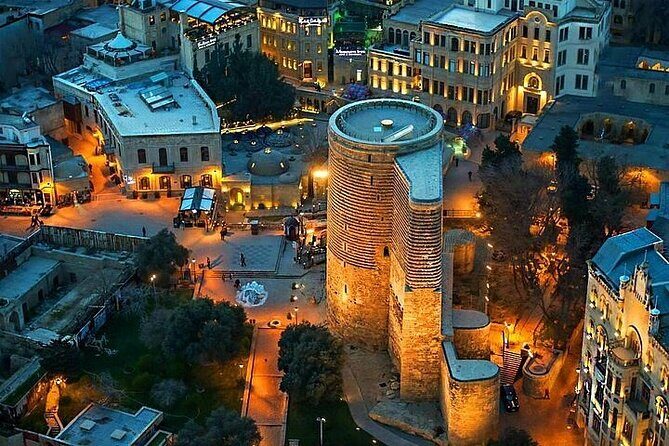
The Maiden Tower (Qız qalası) is a centerpiece of the tour. It’s a 12th-century monument, and UNESCO lists it as part of a historic ensemble alongside the Shirvanshahs’ Palace. It’s one of Azerbaijan’s recognizable national symbols, even appearing on currency notes and official letterheads.
Expect a longer stop here—about 10 minutes—because the tower earns the attention. The guide usually explains the mix of architectural interpretation and the common theme you hear around it: discussions of pre-Islamic influence and Zoroastrian architectural connection. Even if you’re not trying to take a side in the theory, the tower still works as a visual anchor for the whole walk. After seeing gates and caravanserais, you can spot how the city’s defensive and civic functions sit beside symbolic landmarks.
Important practical note: admission to the Maiden Tower is not included. If you want to go inside, budget extra and don’t wait until the last moment.
Bazar square and religious complexes: how daily life worked
From architecture that served travelers and merchants, the tour shifts toward spaces that shaped daily community life. You’ll pass through the Baku Old City area around the Bazar meydanı and the Khanqah complex—an arcade from the 12th to 13th centuries. This is tied to Kichik Gala street and sits near the Maiden Tower area, so it feels like a natural bridge between the symbolic and the practical.
Another quick stop adds more meaning to the religious landscape: the St. Bartholomew Church. Built in 1892 through local Christian donations, it marks a site associated with the Apostle Bartholomew story. The tour also includes the church’s later fate: it operated until 1936, then was demolished as part of the campaign against religion. Even in a short visit, the guide helps you understand why that story belongs in a tour of Icherisheher monuments.
Then you’ll return underground—at least in spirit—with the medieval bath discovered during archaeological research in 1964. This Haji Ghayib or Haji Bani bath was built at the end of the 15th century. The tour focuses on how baths were part of caravan routes and Muslim city life, including the artistic expressiveness of the room designs and the sense of how the interior feels when you step into it.
A strong point of this section is that it shows you religion, trade, and daily routines all intertwined, instead of treating each stop as an isolated postcard.
You can also read our reviews of more city tours in Baku

Gasim Bey Bath and Agha Mikayil Bath House: Old City hygiene as architecture
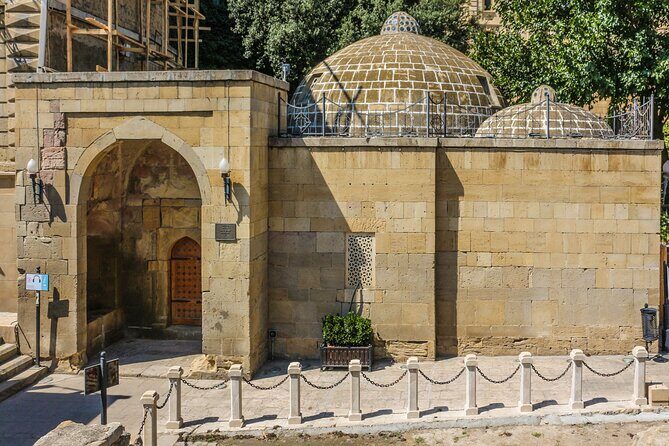
Old City baths are easy to skip if you think only of churches and palaces. This tour makes sure you don’t. You’ll see the Gasim bey Bath, built in the 17th century, also known as the Sweet Bath. The tour notes the bath’s traditional layout: entrance hall, cloakroom, baths, swimming pools, and boiler-house. It’s also explained as having cross-shaped domes and ceramic tubes used for water supply and heating.
Then there’s the Green Pharmacy chapter. In 1970, the bath was reconstructed and turned into a pharmacy with that nickname. That small detail is a great reminder: these buildings didn’t just freeze in time. They were reused as the city changed.
Finally, the tour includes the Aga Mikayil Bath House from the 18th century, built in the south-western part of the fortress on Kichik Gala. The stop highlights how it differs from others, including a large interior and a square plan for dressing room and baths. It’s also described as a functioning bath today after restoration in 2010.
This stretch is one of the most interesting parts for practical travelers. It shows you how technology, comfort, and design were built into everyday routines—without needing a museum ticket to understand why it mattered.
Masques, towers, and fortifications: Juma Mosque and the city walls
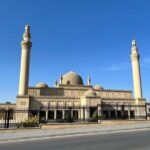
Religious monuments keep the tour balanced. The Juma Mosque (Cümə məscidi) stop is tied to restoration records, including an inscription about an order to restore the mosque in 1309. You also learn about later rebuilding, including the present Friday Mosque built in 1899 with funding from philanthropist merchant Haji Shikhlali Dadashov. The guide notes traces of a Zoroastrian temple at the site too, which helps you see how the layers of belief map onto the same ground.
Another fortification-related stop brings you back to the defensive side of Old City Baku: the Quadrangular Tower. In the Middle Ages, the city had fortress walls on multiple sides, rebuilt many times after attacks. After the last restoration in the 1950s, you’re left with surviving towers along the wall, including 25 semi-circular and one quadrangular. That’s the kind of fact you’ll remember later, because it turns a wall you might otherwise ignore into something measurable.
If you’re the type who likes structure and systems, this part hits.
More than monuments: Ali Shamsi workshop and the miniature books museum
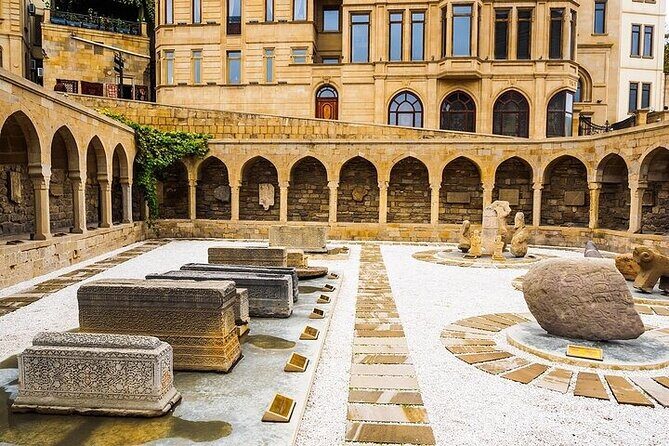
Not every Old City tour adds culture beyond architecture. This one does, in two ways.
First, you visit Workshop Ali Shamsi, an art studio showcasing the works of Azerbaijani artist Ali Shamsi. You’ll get a quick sense of his background: art education, time spent working on icon painting, and his membership in the Union of Artists of Azerbaijan since 1985. This stop works well because it shows you modern creativity happening inside historic streets.
Then you get something truly specific: the Baku Museum of Miniature Books, described as the only museum of its kind in the world. It started operations on April 2, 2002, and the museum’s collection is built from more than 6,500 miniature books from 64 countries collected over 30 years. The tour notes the collection size and also the Guinness Book of Records recognition as the largest private museum of miniature books.
This isn’t just a random detour. Miniature books match the tour theme: tiny details, preserved over time, all within the same old streets.
Shirvanshahs Palace: the big paid highlight
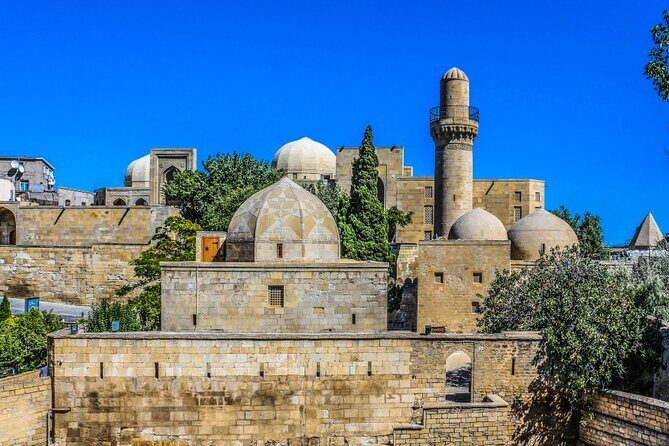
You’ll reach the Palace of the Shirvanshahs, a 15th-century palace built by the Shirvanshahs dynasty. UNESCO describes it as one of Azerbaijan’s architectural pearls, and it sits with the Maiden Tower as an ensemble of historic monuments.
The stop is longer—about 20 minutes—and that extra time makes sense. The palace isn’t just a single building. It’s part of a story about power shifting after a devastating earthquake when the dynasty moved its capital from Shemakha to Baku. The guide connects that political shift to the reason the palace was built.
Admission here is not included, so you’ll want to decide in advance if you want to budget for entry. If you skip paid interiors, you may still appreciate the exterior views and the architecture, but you’ll lose some of the context that the guide shares once you’re inside.
Small reminders that make the tour smoother
A few practical points make a difference when you’re walking through Icherisheher:
- Wear sturdy shoes. Cobblestones and uneven Old City paving are part of the experience.
- Use your time wisely on paid stops. Since Maiden Tower and Shirvanshahs Palace admission aren’t included, check whether you want to pay before you reach those parts.
- Stay close to the guide. The lanes can be narrow, and the tour’s whole structure depends on keeping the group together.
- Expect short stops. Some locations get just a minute or two, so listen closely for the reason the guide is pointing at something.
Also, the tour includes a professional guide, and confirmation happens at booking. It’s offered daily from 10:00 AM to 6:00 PM during the listed operating window, and the activity ends back at the meeting point.
Price and value: is $25 a good deal
At $25 per person for about two hours, the value is best understood in terms of what you’re buying: a route through a UNESCO core plus context that would be hard to piece together alone.
Many stops along the way are free to see, so you’re not paying again and again for basic access. The trade-off is that a couple of major paid highlights—Maiden Tower and Shirvanshahs Palace—are not included, which is common for guided city tours focused on major interiors. If you’re the kind of traveler who likes to enter the big sites, you should budget a bit more for those tickets.
The reviews also praise organization, timing, and the guide’s ability to connect culture, history, and the wider region in a way that feels like a story. One review even calls out that the company’s competitive pricing and trustworthiness help protect you from external scams—exactly the kind of reassurance that matters in busy areas.
Who this tour fits best
This tour is a strong match if you want:
- a structured Old City walk that makes UNESCO sites feel understandable
- local explanations that connect buildings to how people actually lived
- a compact experience that still covers gates, towers, caravanserais, baths, and major palaces
- a small group pace (max 15) so you’re not shouting over everyone else
If you want long museum-style time in just one building, you might find the time at each stop short. But if you want a well-assembled overview that you can build on later, this is a good way to start.
Should you book Alov Travel’s Baku Old City Tour?
I’d book it if you want your first taste of Icherisheher to come with meaning, not just walking. The main reason is the guide-led storytelling and the clean organization—plus the small-group size that helps you actually hear what matters.
I’d think twice if you hate cobblestones, or if you’re only interested in one interior attraction and don’t care about gates, caravanserais, mosques, and baths. In that case, you could spend your time differently.
But for most visitors, this tour hits the sweet spot: 2 hours in the Old City with the kind of guidance that turns a cluster of landmarks into one connected picture.
FAQ
FAQ
How long is the Guided Old City Tour in Baku?
The tour lasts about 2 hours.
What is the price per person?
It costs $25.00 per person.
Where does the tour start, and where does it end?
It starts at Gosha Gala Square, 47 Kichik Qala, Bakı, Azerbaijan, and it ends back at the meeting point.
What time is the tour available?
The listed opening hours are Monday through Sunday from 10:00 AM to 6:00 PM.
Is the ticket digital?
Yes, you receive a mobile ticket.
What’s included in the price?
A professional tour guide is included.
Are entrance fees included for major monuments?
Some admissions are not included, including the Maiden Tower and the Palace of the Shirvanshahs. Other stops list free admission.
How many people are in the group?
The maximum group size is 15 travelers.
What is the cancellation policy?
You can cancel for a full refund up to 24 hours in advance of the experience’s start time. If you cancel less than 24 hours before, the amount you paid will not be refunded.