REVIEW · BAKU
The Best Baku City Tour
Book on Viator →Operated by Baku Sightseeing · Bookable on Viator
Baku has a split personality, and this tour shows both sides. You’ll start in Icherisheher and move through Ottoman-era mysteries, Russian imperial oddities, and oil-era modern Baku in a tight 3–4 hour loop. I love how the route is built around major sights like the Maiden Tower and the Palace of the Shirvanshahs, but it also gives you time to connect the stories to everyday city life.
One possible drawback: not every stop has the same ticket setup. The tour lists some admissions as included, while others are not (like the Maiden Tower, and the Armenian church is noted as not included), so you may want a little extra money ready and a quick check-in with your guide at the start.
In This Review
- Key highlights
- Why this Baku city tour works so well for a first visit
- Price and what you’re really paying for at about $22.10
- Meeting at Icherisheher: the walk style and pacing that matter
- The Inner City start: Maiden Tower, Muhammad Mosque, and UNESCO walls
- Two love stories in stone: Palace of Happiness and the Palace of the Shirvanshahs
- Taghiyev School: how one building maps to political change
- Museum of Miniature Books: tiny size, big effect
- Two mosques, two kinds of meaning: Muhammad Mosque and Juma Mosque
- From palaces to tiny corners to Philharmonic Hall
- Downtown break: Fountains Square, Executive Power, and Baku Boulevard
- Highland Park: the view that ties it all together
- Guides: the difference between a good tour and a memorable one
- Should you book the Best Baku City Tour?
- FAQ
- How long is the Best Baku City Tour?
- How much does the tour cost?
- Is this tour private?
- Do I get a mobile ticket?
- Which admissions are included, and which are not?
- Is free cancellation available?
- What if weather is bad?
Key highlights
- Maiden Tower mystery: one of Baku’s best-known landmarks, with origins that no one can pin down
- Tiny books, serious collecting: the Museum of Miniature Books (only one of its kind, per the tour info)
- Mosques with big backstories: Muhammad Mosque’s minaret damage story and Juma Mosque’s fire-worship origins
- A palace you can walk through: the restored Shirvanshahs complex includes multiple linked buildings
- Big-city Baku energy: Fountains Square and the Caspian seafront boulevard breaks up the old-city pace
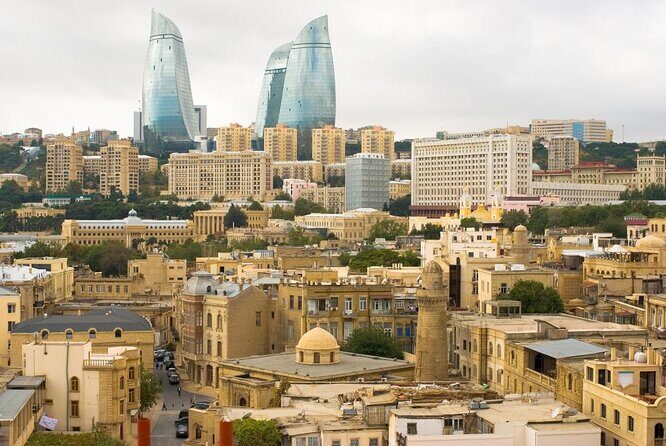
- Panoramic payoff: Highland Park gives you a view over the bay and the modern skyline
Why this Baku city tour works so well for a first visit
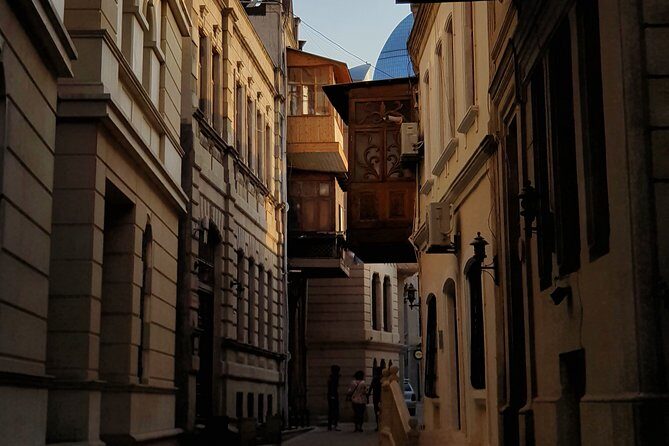
This is the kind of Baku tour that helps you get your bearings fast. In just a few hours you’ll touch both the storybook side of the old walled core and the more polished downtown and seafront areas.
I like tours like this because Baku isn’t one uniform vibe. The old part feels tight and historic, with stone streets and thick walls. The modern stretch feels wider and more open, with the Caspian breeze and city bustle. You’ll see how those two worlds sit side-by-side.
And you’ll usually walk enough that you don’t just glance at things—you actually notice details. The best moments aren’t the loud photo stops. They’re the in-between ones, where you learn why a building was built, or why a place has two names.
You can also read our reviews of more city tours in Baku
Price and what you’re really paying for at about $22.10
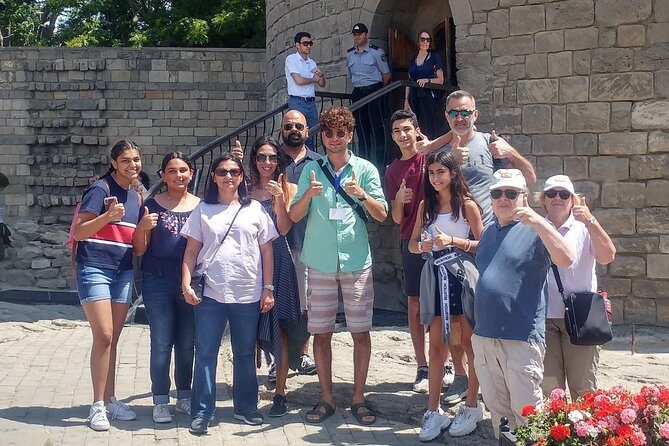
At about $22.10 per person for a 3–4 hour private experience, the value comes from two things: guided context and multiple attractions packed into one route. You’re not paying for one building and then wandering alone after.
The tour also leans practical. Several stops list admission as included—like the Palace of Happiness, the Former Taghiyev School for Girls (Institute of Manuscripts of Azerbaijan), the Museum of Miniature Books, Muhammad Mosque, Baku Old City, the Executive Power building, and time on the boulevard. Other stops are marked as not included, including the Maiden Tower and the Armenian Church of Baku.
So here’s the simple way to think about it: you’re paying to have someone connect the dots across old and modern Baku, while you still get to enjoy included admissions at several key spots. If you like a guided hit-list that still feels like a real walk around town, this price makes sense.
Meeting at Icherisheher: the walk style and pacing that matter
You’ll start and end back at Icherisheher (Inner City). That’s smart because it keeps logistics easy and puts you in the historic zone right away. The tour is private, meaning it’s only your group, not a big mixed crowd.
The info you get also points to a moderate walking pace and a moderate fitness level. That matters in Baku because old-city streets can be uneven, and the route includes multiple stops close enough to keep the day moving.
One more practical point: some sights are outdoors and quick. Others are ticketed and slower. Expect short time windows—often around 10 to 20 minutes at individual stops—so if you love linger-time, plan to spend a few extra minutes after the tour on your favorite area.
The Inner City start: Maiden Tower, Muhammad Mosque, and UNESCO walls
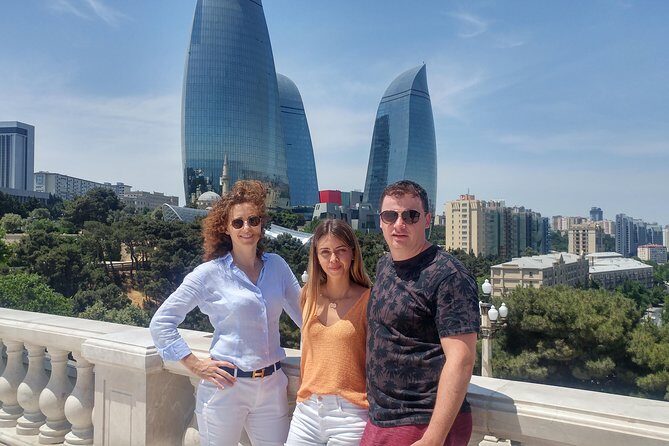
The tour’s opening energy is set by the Maiden Tower. It’s dark and enigmatic-looking from the old walled city edge, and the mystery is part of its power. The tower’s origins aren’t pinned down—no surviving written sources record when it was built, what it was built for, or how it got its name (Qiz qalasi / Maiden Tower). That uncertainty makes it feel like a living legend instead of a solved puzzle.
Next you’ll head into the religious and defensive fabric of the old core, including Muhammad Mosque (also known as Siniggala). This one has a story that’s tied to conflict and damage. It’s described as an 11th-century mosque in Old City Baku, and its second name comes from a damaged minaret—Siniggala. In 1723, Russian warships approached during the Russo-Persian War, demanded surrender, bombed the city after refusal, and a shell hit the minaret, which became the key detail people remember.
Then you’ll move through Baku Old City (Icherisheher) itself. This is the ancient core surrounded by defensible walls, and it’s UNESCO-listed. The tour info notes that the Old City became a UNESCO World Heritage Site in 2000, including the Palace of the Shirvanshahs and Maiden Tower. You’ll also hear about the small population living there (the tour data cites about 3,000 residents in 2007).
What I like here: these aren’t just monuments. They’re part of a real neighborhood fabric where history is still stacked right on top of daily life.
Ticket note: Maiden Tower is listed as admission not included, while Muhammad Mosque and Baku Old City are listed as included.
Two love stories in stone: Palace of Happiness and the Palace of the Shirvanshahs
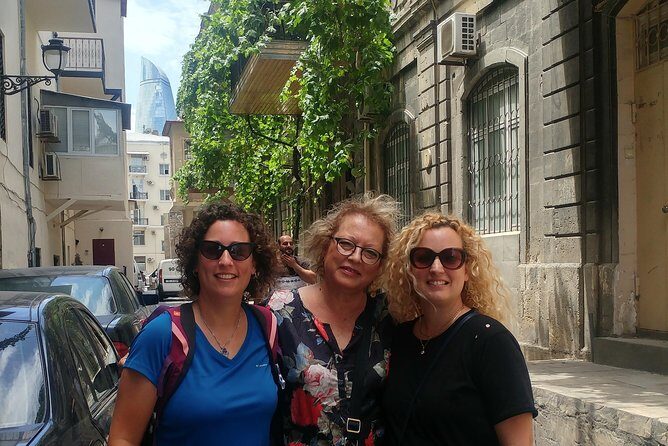
The tour pivots from mystery to romance with the Palace of Happiness. This building is tied to millionaire Muxtarov, who—according to the tour info—built it as a surprise Valentine gift for his second wife. She allegedly had adored a similar building she’d seen during a grand tour in Italy, so Muxtarov paid the Qasumov brothers to build a copy.
It’s a small story, but it’s a useful one. It shows how Baku’s oil-era wealth wasn’t only about power and industry. It was also about style, status, and personal drama that left physical marks on the city.
Later you’ll step into the Palace of the Shirvanshahs complex, and this is one of those places where a short walk inside actually pays off. The tour info describes the complex as nine buildings recently restored. As you move through pavilions, courtyards, palace rooms, the crypt, cistern, Turskih bathhouses, and mosque areas, you get a sense of how daily life worked within palace walls.
This is also one of the few stops that’s explicitly marked as free admission and has time built in (20 minutes listed). That means you can spend the mental budget on details instead of juggling tickets.
If your time in Baku is short, this is the stop I’d prioritize for first-time visitors. It’s the most “walkable architecture story” in the bunch.




Taghiyev School: how one building maps to political change
The Former Taghiyev School for Girls (Institute of Manuscripts of Azerbaijan) is one of the most educational stops on the route, not because it’s flashy, but because the timeline is dramatic.
The building’s role shifts in the tour info across several political eras:
- From September 1901 to March 1918: it operated as the Empress Alexandra Russian Muslim Boarding School for Girls.
- From December 18, 1918 to April 20, 1920: Taghiyev gave the building to the Parliament of the first Democratic Republic of Azerbaijan (DRA).
- It’s described as the first European-style Parliament in the Muslim world.
- The tour info notes the parliament continued for about 23 months, ending when the Bolsheviks invaded Azerbaijan in April 1920.
So what do you actually do with this information on site? You look at the same walls and realize they served totally different purposes depending on who had power. That’s a powerful way to understand Azerbaijan’s modern history without getting lost in names and dates.
Admission is listed as included for this stop, and the listed time is 15 minutes.
Museum of Miniature Books: tiny size, big effect
If you want a break from mosques and palaces, this stop does it—without feeling random. The Museum of Miniature Books is described as the only museum of miniature books in the world, and it’s located in the old part of Baku (Inner City). It started on April 2, 2002.
The collection is the star. The tour info says that the exhibits were collected by Tahir Salahov’s sister, Zarifa Salahova, over 30 years, totaling more than 6,500 books from 64 countries. You’ll also hear the collection includes miniature books from post-revolutionary Russia and the Soviet period, plus items from Moldova, Georgia, Ukraine, Belarus, and republics of Middle Asia and Europe.
There are also rare editions listed, including works by Chukovsky, Barto, Gogol, Dostoyevsky, and A. S. Pushkin.
And here’s why this stop is valuable for real travelers: it resets your brain. After reading about grand politics and imperial power, you get to appreciate something human-scale—attention to craft, printing, and the joy of small things.
Admission is listed as included, and you’ll have about 20 minutes.
Two mosques, two kinds of meaning: Muhammad Mosque and Juma Mosque
Baku’s old city religious architecture comes with stories that go far beyond worship. The tour includes Muhammad Mosque (Siniggala) early, where the minaret damage story connects to the Russo-Persian War and local interpretation of wind after the ships were pushed away.
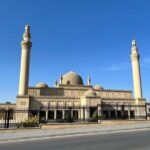
Later, you’ll also see Juma Mosque in Icherisheher. The tour info says it’s been functioning since the 12th century. The mosque itself was built in 1899 with funds from Baku philanthropist Khadja Shikhali Dadashev, and it sits on the site of an older temple of fire worshipers. It mentions that only four uncoated arches remained from the older structure and that modern archaeologists suggest there was a pagan sacred center there.
The tour info then describes a conversion in the 14th century, where a pagan temple became a mosque. There’s also a specific historical inscription mentioned: in Rajab 709 Hijri (1309), Amir Sharaf al-Din Mahmud ordered something at the site.
Even if your brain usually skips religious history, this one sticks. It shows how places change role across centuries, but the site’s significance lingers.
From palaces to tiny corners to Philharmonic Hall
Baku has a talent for mixing serious culture with a little surprise, and the tour keeps sliding between them.
After the miniature books, you may pass through or stop near the Azerbaijan State Philharmonic Hall area. The tour info gives a real architecture story: construction ran from 1910 to 1912, requested by the city elite, designed by Armenian architect Gabriel Ter-Mikelov. The exterior is described as Italian Renaissance style, and the interior is German Rococo style. The design inspiration is said to connect to Monte-Carlo Casino, especially l’Opéra de Monte-Carlo.
Even if you don’t go inside (the tour info doesn’t clearly say ticketed entry here), the building is worth noticing because it shows how Baku’s cultural ambitions looked toward Europe during the oil boom.
If you like architecture as much as history, this stop gives you a satisfying visual contrast to the older stone world of the Inner City.
Downtown break: Fountains Square, Executive Power, and Baku Boulevard
To keep the day from feeling like only old stones, the tour includes downtown and seafront time.
You’ll reach Fountains Square, described as a public gathering place in downtown Baku. It was previously called Parapet, and the name comes from dozens of fountains constructed during Soviet rule. This is the kind of place where people-watchers have fun: boutiques, restaurants, shops, hotels, and passageways, with locals strolling after business hours and on weekends.
Next is Baku City Executive Power, where the building’s history is tied to early 1900s Baku. The tour info says construction started in 1900 and finished in 1904, with architect I. Goslavski (born in Warsaw). It notes baroque style and classic construction methods. The facade used red brick brought from Italy, plus colored marble. The emblem on the facade includes three golden torches symbolizing Azerbaijan as the land of fire.
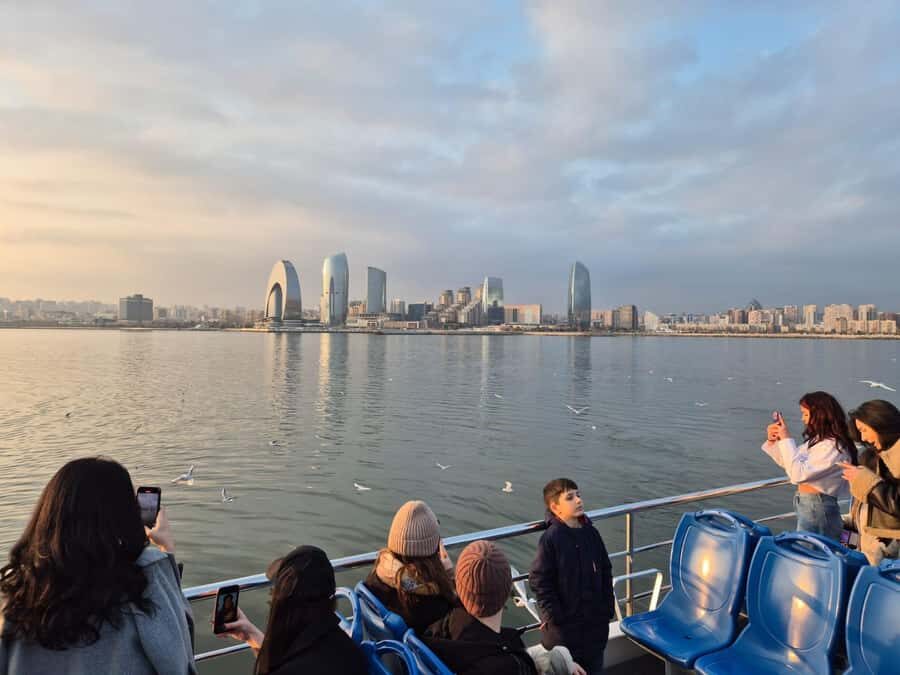
Then you’ll get to the Baku Boulevard, along the Caspian seafront. The tour info describes the boulevard as a promenade established in 1909, running parallel to Baku’s seafront, with a history tied to oil barons who built mansions along the shore. It also describes the boulevard size as about 3 km and 750 m, starting at National Flag Square and ending at Freedom Square. The tour data even notes plans for expansion to 26 km covering areas including Bibiheybet and Bay of Baku by 2015.
I like this part because it lets you breathe. You stop thinking in terms of dates and start thinking in terms of place: the sea air, the wide walking space, and the city’s modern confidence.
Highland Park: the view that ties it all together
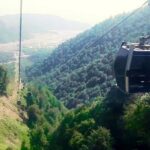
Near the end (or later depending on the exact pacing), the tour includes Highland Park. This is Baku’s upland park and the highest point in the city, built for panoramic views over the bay and the skyline. The tour info notes you can reach it by cable railway (funicular) in about 7–8 minutes from the boulevard, or by climbing the stone stairs.
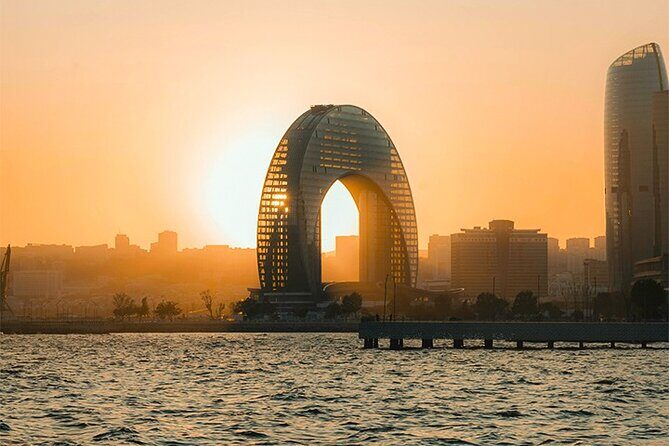
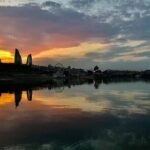
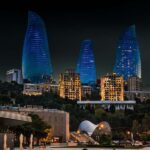
The tip in the tour info is worth following: it’s often better to enter from the top area—near the square that includes the country’s parliament, the Alley of Martyrs, and the world-famous symbol of modern Baku, the Flame Towers.
Highland Park is also listed as free admission, with 30 minutes available. If you want that “now I understand this city” moment, this is where it happens.
Guides: the difference between a good tour and a memorable one
A walking tour lives or dies by the guide. The reviews included in the tour’s background point to a pattern: when the guide is doing the job well, you leave with both facts and confidence to roam later.
Some names that show up in the feedback: Abdullah, Huseyn Ourbakli, and Mohammad. What stands out across those comments is how they explain things clearly and keep the pace friendly—enough info to learn, not so much that you feel lectured.
A couple details you can use right away:
- Ask your guide at the start if today’s plan matches the full set of stops you’re expecting. One review mentioned a mismatch between advertised and actual coverage, which is the kind of thing you can prevent with a quick check.
- If you’re traveling with someone older or you just don’t want a sprint, say so early. Multiple comments praised guides for being patient and friendly and for pacing so people could linger.
- If you like conversation, this tour type is set up for it. Several reviews mention wide-ranging chats about life in Baku, not only dates and monuments.
Also, one negative note showed up about a guide being late and not meeting expectations. That’s not the norm, but it’s a reminder to treat the start time seriously and give yourself buffer time if you’re joining from a hotel.
Should you book the Best Baku City Tour?
I’d book it if you’re a first-timer and you want an organized way to see Icherisheher, key museums, major mosques, palace architecture, and the Caspian-side Boulevard in one morning/afternoon. At about $22.10 with multiple included admissions, it’s also a smart way to control costs without skipping the important stops.
I’d think twice if you’re the type who wants a perfectly timed checklist every single time. The tour’s own feedback includes at least one case where fewer listed stops were covered. If that would bug you, do this one simple thing: confirm your expectations with the guide right at the start, and keep your must-see priority list to 2–3 items.
FAQ
How long is the Best Baku City Tour?
It runs about 3 to 4 hours.
How much does the tour cost?
The price is listed as $22.10 per person.
Is this tour private?
Yes. It’s a private tour/activity, and only your group participates.
Do I get a mobile ticket?
Yes. The tour includes a mobile ticket.
Which admissions are included, and which are not?
Some stops list admission as included (for example: Palace of Happiness, Former Taghiyev School/Institute of Manuscripts, Museum of Miniature Books, Muhammad Mosque, Baku Old City, and others). Other stops list admission as not included, including the Maiden Tower and the Armenian Church of Baku.
Is free cancellation available?
Yes. Free cancellation is available up to 24 hours in advance for a full refund.
What if weather is bad?
This experience requires good weather. If it’s canceled due to poor weather, you’ll be offered a different date or a full refund.