REVIEW · BAKU
Baku by Night: Small-Group Walking Tour
Book on Viator →Operated by Baku Explorer · Bookable on Viator
Baku changes character after dark. On this 3-hour night walk, you’ll see Baku’s old walls and the Maiden Tower glowing in the dark, plus the Flame Towers rising above the city. The one catch: it’s still a walking tour, with some steps and nighttime standing, so wear comfy shoes.
What I like most is the way the tour mixes big sights with human stories. Guides such as Sabina, Aydan, and Vusal have a knack for explaining Azerbaijan’s past and present in plain language, and that matters most when you reach Martyrs’ Lane.
For the price, I think this tour is strong value. You’re paying about $49 per person for a local guide, bottled water, and the funicular ride, with the only add-on being your own beer or tea at the end.
In This Review
- Key highlights worth your attention
- A night-shift walk through old Baku and the Flame Towers
- Start at Icheri Sheher: 12th-century walls and a 1912 landmark
- Funicular to the hilltop: sea views, Flame Towers area, and Daghustu Park
- Martyrs’ Lane: a solemn stop that actually explains why it matters
- Flame Towers under the lights: symbolism, shape, and a quick photo window
- Baku Boulevard finale: Maiden Tower stories plus sea-breeze drinks
- Price and value: why $49 can make sense for a night in Baku
- What the group size changes in a good way
- Who this tour is for (and who should skip it)
- Should you book Baku by Night? My decision guide
- FAQ
- How long is the Baku by Night walking tour?
- Where do I meet the guide?
- What is the tour route like?
- What does the tour price include?
- Are food and drinks included?
- How large is the group?
- Where does the tour end?
- Is free cancellation available?
Key highlights worth your attention
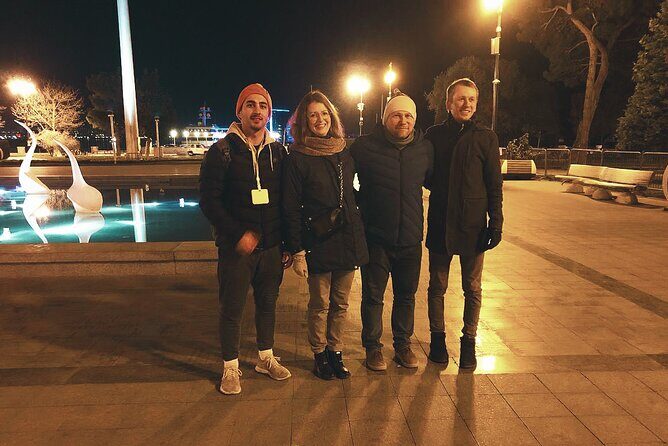
- Night lighting across old and new Baku in one smooth walk
- UNESCO World Heritage-listed Maiden Tower in evening mood
- Funicular ride for a hilltop view and easy photo angles
- Martyrs’ Lane memorial tied to Black January 1990 and Nagorno-Karabakh history
- Flame Towers symbolism explained through Zoroastrian references
- Baku Boulevard finale by the Caspian Sea, with optional local beer
A night-shift walk through old Baku and the Flame Towers
This tour gives you a “two-speed city” experience: centuries-old stone next to bold modern towers. In daylight, Baku can look like it’s split into zones. At night, the light strings it together, so you feel how the city grows while still holding tight to its roots.
You’ll cover a lot of ground for just three hours, but it doesn’t feel like a race. It’s a guided pace through key areas—old city streets, a hilltop viewpoint, and the waterfront—so you get the broad picture fast. And because the group is capped at 18 travelers, the guide can keep things moving without feeling rushed.
You can also read our reviews of more walking tours in Baku
Start at Icheri Sheher: 12th-century walls and a 1912 landmark
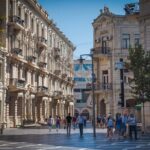
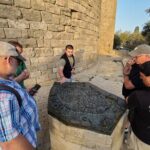
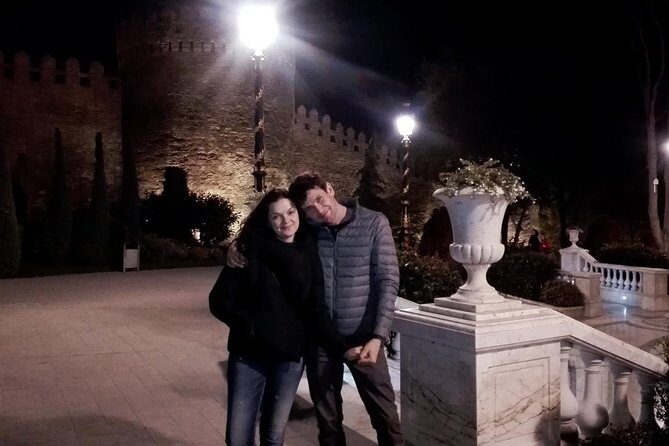
You meet at the central Ichersheher metro station area, then step into Baku’s older layer right away. The first big moment is the Fortress Walls of Icheri Sheher, which trace back to the Shirvanshahs era. At night, these stone walls feel less like a photo backdrop and more like part of the city’s living spine.
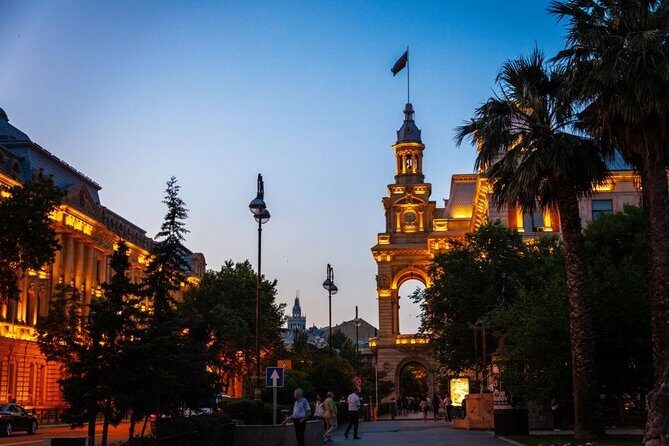
From there, you walk toward the Philharmonic area and the garden setting. The tour also points out the building of the Philharmonic, built in 1912 and inspired by the design of the Monte Carlo casino. Even if you’ve seen ornate buildings before, it helps to place this one in Baku’s story of European influence—because the city isn’t only Eastern or only Western. It’s both.
Practical tip: give yourself a little time for photos here. Night lighting can make details pop, but it also increases glare. Moving your phone slightly lower or higher than eye level often fixes it quickly.
Funicular to the hilltop: sea views, Flame Towers area, and Daghustu Park
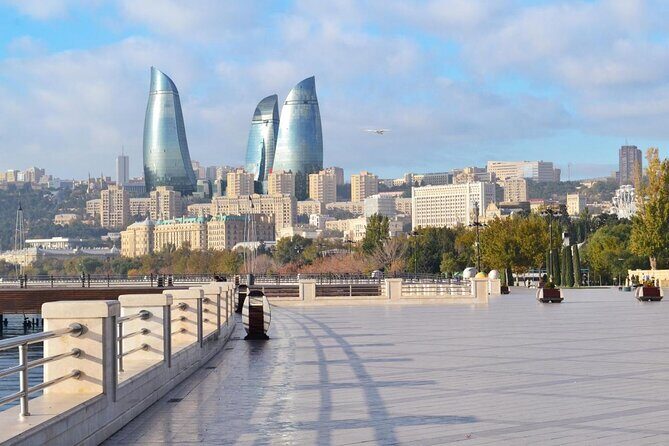
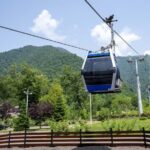
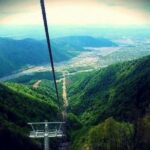
The tour then heads to the Baku Funicular, and this part is a treat if you’re trying to get panoramic views without draining your legs. You’ll ride up to the hilltop, where the city bay view opens up for photos.
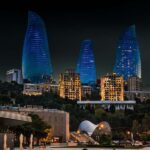
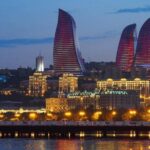
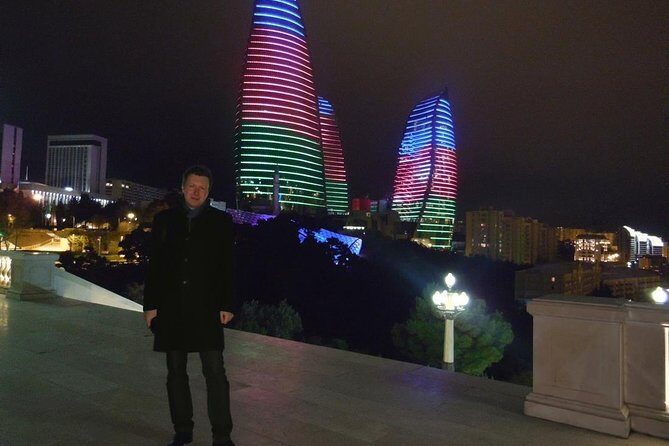
This stop is also where the modern Baku gets loud. You’ll spend time in the area with the Flame Towers, the trio of skyscrapers designed to symbolize fire. The symbolism is explained in plain terms, not just as a design claim—fire here links back to Ahura Mazda and Zoroastrian tradition, so the towers feel less like random skyline decoration.
You also visit Martyrs’ Lane from this higher route, and you’ll hear why this memorial carries weight far beyond scenery. When you come back, you pass Uphill Park, also known as Daghustu Park, which gives you another change of mood before you head toward the waterfront.
Possible drawback: the funicular and the viewpoint area can mean more standing than you expect. If you don’t like holding still in a line or on a windy hilltop, factor that in. The upside is that you get better angles than you would from street level.
Martyrs’ Lane: a solemn stop that actually explains why it matters
Martyrs’ Lane, formerly known as Kirov Park, isn’t a quick “see-and-go” moment. It’s a cemetery and memorial honoring people killed by the Soviet Army during Black January 1990, and those who died in the Nagorno-Karabakh War from 1988 to 1994.
This is the stop where I think the tour earns its place. Night tours can sometimes skip the serious parts of a city because darkness makes them feel easier to gloss over. Here, you get context for what the site represents for Azerbaijani people, not just where it is on a map.
You’ll typically spend about 15 minutes at this stop. That’s enough to read the basics, listen to the guide’s explanation, and understand the emotional gravity without dragging out the moment.
If you’re sensitive to memorials: go in with the right mindset. This is not the time for side-tracking into selfies and jokes.
Flame Towers under the lights: symbolism, shape, and a quick photo window
After Martyrs’ Lane, the tour includes a focused Flame Towers moment. You’ll get a short stop here—about 10 minutes—long enough to take photos and understand the design story, but not so long that it turns into waiting around.
The “fire” concept is the key takeaway. The towers represent flames as a sign connected to Ahura Mazda in Zoroastrianism. That detail helps you read the architecture instead of just admiring it. You’ll also hear that the towers were featured in Extreme Engineering, a documentary series that aired on Discovery Channel and Science Channel. That’s useful context if you like knowing how buildings travel into global media.
Photo tip that saves time: at night, Flame Towers photos can suffer from motion blur if you’re on uneven ground. Take one test shot first, then adjust your stance and shutter speed if your phone allows it. If not, steady both elbows and hold your breath briefly.
You can also read our reviews of more evening experiences in Baku
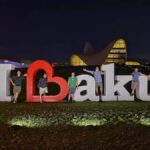
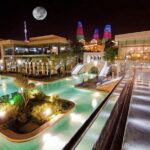
Baku Boulevard finale: Maiden Tower stories plus sea-breeze drinks
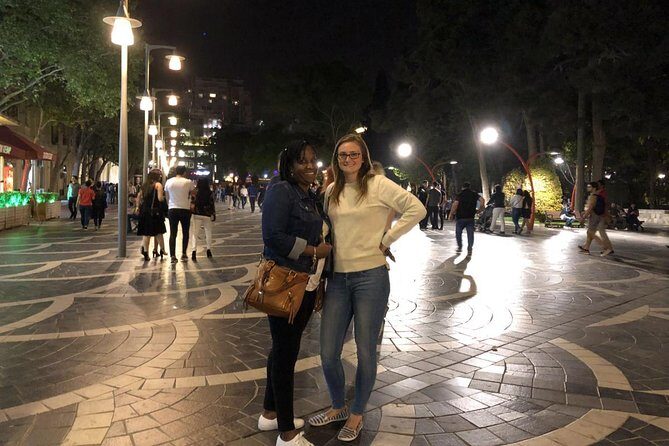
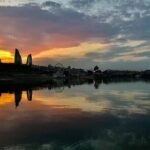
Next you move toward the city center and down the boulevard. This is where the evening relaxes a bit. You’ll walk through the promenade with the guide, taking in the waterfront rhythm and the mix of attractions along the way.
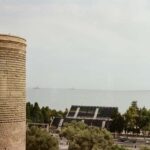
You’ll pass the area sometimes called Baku Venice and also the Carpet Museum zone on the boulevard. The tour then threads you back toward the ancient side with the Maiden Tower. This matters because you’ll see the Maiden Tower in two different ways on the same evening—first as a UNESCO-listed highlight during the night walk, then again through the boulevard context.
The guide shares stories about the Maiden Tower’s architect and legends surrounding it. Those details make the tower feel more like a cultural object than a single photo subject. You end with a chance to choose your own nightcap by the shore of the Caspian Sea—beer or tea at your own expense.
Small note on cost: the tour includes bottled water, but food and drinks aren’t included. If you want beer or tea, plan for it.
Price and value: why $49 can make sense for a night in Baku
At $49 per person, this tour isn’t the cheapest way to see Baku. But it’s also not overpriced for what you get: a local guide, bottled water, and a funicular ride, all within about three hours.
The funicular inclusion is a big part of the value. A lot of walking tours offer views, but fewer include the transit element that helps you reach hilltop angles efficiently. You also get a structured route through major stops without needing to stitch together tickets and directions yourself.
Demand seems real, too. This experience averages booking about 12 days in advance, which tells me popular departures can fill up. If you have fixed plans, don’t wait until the last minute.
Group discounts can apply for some bookings, so if you’re traveling with friends, check that when you reserve. And you’ll receive a mobile ticket, which usually keeps things simple on arrival.
What the group size changes in a good way
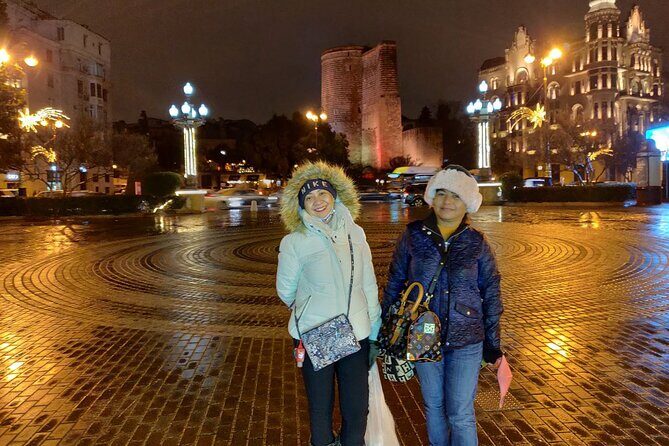
With a maximum of 18 people, you avoid the “walk-and-hope” feeling that can happen on big group tours. Smaller groups also help at the viewpoints, where standing space is limited and photo time matters. You’ll likely hear the guide clearly at stops, and you can ask questions without feeling like you’re interrupting a factory line.
The tour also works best as a first-night experience. In one evening, you cover key old-city elements, a memorial site, the modern skyline, and the waterfront. That gives you a mental map for later days—so when you roam on your own, you know what you’re looking at.
Who this tour is for (and who should skip it)
This tour fits you best if you want:
- A guided overview of both historic and modern Baku
- A night setting with good lighting for photos
- A mix of architecture and context, including the memorial stop
It may not fit as well if:
- You don’t enjoy walking at night
- You prefer long stops over quick photo windows
- You want food included as part of the price
Most travelers can participate, and service animals are allowed. If you have mobility concerns, the hilltop viewpoint and walking between areas are the main factors to consider. Wearing supportive shoes is the practical move.
Should you book Baku by Night? My decision guide
Book it if you want one evening that links Baku’s story from the old city walls to the Flame Towers, with the Maiden Tower placed front and center. The price feels reasonable because the guide plus funicular ride reduces the work you’d otherwise do on your own. And the best part is that the tour doesn’t treat serious history like an afterthought.
Skip it if you’re trying to do Baku on pure autopilot, or if you dislike memorials. Also, if your idea of a great tour is long lingering time at each place, this one is more about a smart route and a set rhythm.
If you’re deciding between sleeping in and getting oriented, this is a strong choice. Night in Baku turns the city into a story you can read quickly.
FAQ
How long is the Baku by Night walking tour?
It runs for about 3 hours.
Where do I meet the guide?
You meet at the central Ichersheher metro station area in Baku.
What is the tour route like?
You walk through Icheri Sheher and its city walls, take the funicular to a hilltop viewpoint, visit Martyrs’ Lane, see the Flame Towers, and finish along Baku Boulevard near the Caspian Sea.
What does the tour price include?
The tour includes a local guide, bottled water, and the funicular part of the outing (the funicular admission is listed as included).
Are food and drinks included?
No. Food and drinks aren’t included. You can choose to buy local beer or tea at the end by the shores.
How large is the group?
The tour has a maximum of 18 travelers.
Where does the tour end?
It ends at Tosca restaurant, close to the Sahil metro station.
Is free cancellation available?
Yes. You can cancel up to 24 hours in advance for a full refund.